







TalkWorks owes SPECIAL THANKS TO -
ANDY RUSSELL of DIFFERENT FILMS  - Co-producer, cameraman and editor of all films in Series Two and of TalkWorks’ promotional film, and for project development consultancy from September 2009

We are particularly grateful to our EXPERT CONTRIBUTORS, all extremely committed and busy people, who give freely of their time and specialist expertise to this project. They represent a broad range of academic disciplines and practical experience and come from diverse political and cultural backgrounds, but share a desire to pursue whatever steps are necessary to avert a future nuclear catastrophe.
Their audience is potentially a very large number of concerned and responsible citizens from all over the English-speaking world who are seeking a better understanding of nuclear issues and wider global security questions, but do not have access to people with expert and practical knowledge nor the time or inclination to follow the specialist journals.http://www.different-films.comshapeimage_2_link_0
CONTACT:
Rosie Houldsworth
PEOPLE:
PROJECT CO-FOUNDERS & COORDINATORS
ANNE PIPER & ROSIE HOULDSWORTH
PROJECT ASSOCIATE
ANDY RUSSELL of DIFFERENT FILMS

THANKS
To the original project advisers:
Lorna Arnold, Frank Barnaby, Wendy Barnaby, Frank Boulton, Chris Herdman-Newton, Mary Midgley, Oliver Ramsbotham, Peter Houldsworth
To those who helped me set up TalkWorks in 2009 by assisting voluntarily in the various tasks that needed doing:
Sebastian Elmaloglou, for camera and online film editing of the entire first series
David Abramsky & Harriet Macdonald, for online film editing assistance 
Robin Bloomfield www.rjbloomfield.com and Dan Goren, for website support   
Christopher Jarman, for the anchor Logo design www.quilljar.btinternet.co.uk 
Tom Midgley, for IT support http://www.computerheroes.co.uk/
Neil Darby & Chris Abbott, for help with the transcription of  interviews.
                                                                                mailto:rosie.houldsworth@talkworks.infohttp://www.different-films.comhttp://www.pool.org.au/users/harriet_macdonaldhttp://www.rjbloomfield.comhttp://webdesign.dangoren.comhttp://www.quilljar.btinternet.co.ukhttp://www.computerheroes.co.ukhttp://www.chrisabbott.info/shapeimage_3_link_0shapeimage_3_link_1shapeimage_3_link_2shapeimage_3_link_3shapeimage_3_link_4shapeimage_3_link_5shapeimage_3_link_6shapeimage_3_link_7
SPONSORS OF TalkWorks
We are grateful to the original sponsors of TalkWorks whose financial and moral support enabled us to embark on the first set of films, and establish a dedicated YouTube channel and website.
These are:
THE FAITH RAVEN CHARITABLE TRUST FUND;  THE MARGARET HAYMAN CHARITABLE TRUST FUND;  CHRISTOPHER HERDMAN-NEWTON; THE W F SOUTHALL TRUST; THE MARMOT TRUST; LADY EPSTEIN; THE AW.60 CHARITABLE TRUST; THE WESTCROFT TRUST; THE PETER HOULDSWORTH EDUCATIONAL FUND (from African sales of Longmans’ Pure Mathematics 1 & 2, Backhouse, Houldsworth & Cooper)

We are also grateful to those who gave financial support to take the project forward in September 2009 with the second series, and to make TalkWorks’ promotional film,
   ‘Signs for Hope - Talking About Nuclear Disarmament’
        (April 2010) 
These are:
THE MARMOT TRUST; THE POLDEN-PUCKHAM CHARITABLE FOUNDATION; TERESA ELMALOGLOU; PROFESSOR ANDREW BROWN; THE ALLAN & NESTA FERGUSON CHARITABLE TRUST; THE ATOMIC MIRROR/JANET BLOOMFIELD MEMORIAL FUND; THE WESTCROFT TRUST; SAFFRON WALDEN QUAKER MEETING; THE MULBERRY TRUST.

We operate on an absolutely minimal budget and urgently seek further sponsorship to carry our work forward
Throughout 2011 TalkWorks aims to continue:
-  to make new films tracking developments in multilateral nuclear disarmament from the point of view of those most closely involved in moving the agenda forward, both within the UK and internationally 
- to update, replicate and disseminate to regional & local citizen groups and to schools and colleges copies of the DVD of our public awareness-raising short film, Signs for Hope
Signs_for_Hope.htmlhttp://www.youtube.com/watch?v=0KP6XTYzkuoSigns_for_Hope.htmlshapeimage_4_link_0shapeimage_4_link_1shapeimage_4_link_2


Wall Street Journal

January 15, 2008


The accelerating spread of nuclear weapons, nuclear know-how and nuclear materials has brought us to a nuclear tipping-point….. we call  for a global effort to reduce reliance on nuclear weapons…and ultimately to end them as a threat to the world.”


George Shultz

Henry Kissinger

William Perry

Sam Nunn

Read “Winning For Peace”

by Janet Bloomfield, January 2006


TalkWorks grew out of the Niwano Peace Prize-winning work of the Oxford Research Group.
At the height of the Cold War from the early 1980s and during the 1990s ORG sought to “put a human face on the nuclear arms race”.  Under its founder-director Scilla Elworthy, and supported mainly by Quaker charitable trusts, the group promoted dialogue with and between nuclear weapons decision-makers and researched alternative and more effective ways for civil society to respond to the nuclear arms race other than simply protesting in anger or signing petitions. The group published on the people, structures and processes of nuclear weapons decision-making in all the nuclear countries, NATO and the Warsaw Pact, and developed and promoted an innovative method of non-confrontational informed political dialogue with defence decision-makers, which was shared with citizen groups all over the country and developed in parallel projects in the United States and Sweden.
Before the term ‘Track II diplomacy’ was invented, ORG began to invite nuclear officials at senior levels from all the nuclear nations to meet each other and their critics face-to-face in informal, safe environments in order to try to break through the deadlocks in international disarmament negotiations. In the presence of independent experts and skilled mediators, ORG facilitated off-the-record consultations under the guidelines of the method we came to call The Oxford Process. The method applies to political conflicts and involves attentive listening to adversaries with whom you radically disagree, where dialogue rather than debate is encouraged. In this way, it was found that new insights could begin to emerge where previously there had been an intractable stalemate, and an atmosphere of trust on a human level could begin to develop. This in turn often led to cooperation between former political opponents on developing strategies to reduce nuclear threats and prevent proliferation, to their mutual benefit. These dialogues included the organisation and facilitation of a series of groundbreaking exchanges, starting in 1985, with Chinese nuclear weapons experts and decision-makers and their counterparts from other nuclear nations, at meetings in Beijing and Oxford.
Later ORG’s research expanded to look at broader issues of global security through an holistic lens, and to understand and promote effective ways of dealing with the underlying root causes of international terrorism, violent armed conflict and the proliferation of weapons of mass destruction.
In 2003 Scilla Elworthy was awarded the Niwano Peace Prize for this work, and went on to found PeaceDirect and advise Richard Branson and Peter Gabriel in setting up the Elders Initiative


In December 2007 ORG stopped working on nuclear issues in order to concentrate its resources on  promoting Professor Paul Rogers’ sustainable security approach to global threats, and to continue to promote methods of transforming conflict by non-violent means with a special focus on Israel-Palestine.


A high-level international symposium on ‘Nuclear Futures: Realities and Choices’ was held at the Royal Society of London to mark the ending of ORG’s 25-year nuclear programme and to honour its eminent scientific consultant on nuclear issues, Dr Frank Barnaby.

ROYAL SOCIETY SYMPOSIUM, December 2007
‘Nuclear Futures: Realities and Choices’


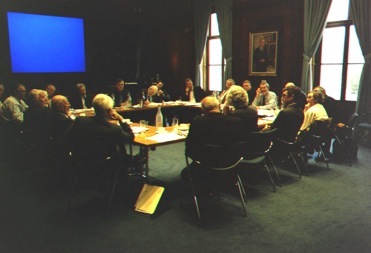
The symposium was co-hosted by the The David Davies Memorial Institute for International Studies (DDMI) and its new programme, Trust Building in Nuclear Worlds.  Twenty-five of the most knowledgeable and experienced nuclear and global security experts and leading diplomats and politicians were invited to jointly assess the current critical situation with regard to nuclear proliferation and the increased risks of nuclear terrorism, and to discuss what could be done about it.  The discussion was launched by Frank Barnaby’s keynote paper:
Consequences of a Nuclear Renaissance
& graph showing:
‘World Nuclear Power Reactors & Uranium Requirements’
You can read the report of the symposium in: Nuclear Futures?

TalkWorks’ Forum for Dialogue on Nuclear Futures, June 2008


TalkWorks’ initial activities in 2008 involved supporting the continuation of dialogue among non-government organisations (NGOs) and other specialists working in the nuclear disarmament and international security field, and to promote the wider dissemination of their insights into the public domain. In this we were continuing the work of the late Janet Bloomfield who, before she died suddenly in April 2007, had been writing and speaking widely on how peace and disarmament NGOs can make their work more effective.

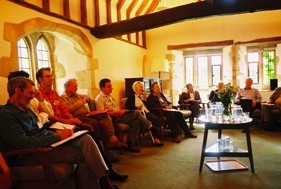
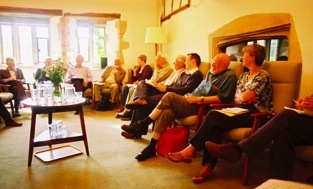
In June 2008 TalkWorks convened a 24-hour ‘Forum for Dialogue on Nuclear Futures’ at Charney Manor, the Quaker retreat and conference centre in Oxfordshire, to enable thirty leaders of UK-based NGOs, academics and other nuclear specialists to come together with those who fund their work to assess the implications of the fact that nuclear strategists and political leaders worldwide were beginning to take nuclear disarmament seriously. The meeting explored how they may best support the US-led disarmament  initiative during the critical period leading up to the May 2010 Non-Proliferation Treaty (NPT) Review Conference, and beyond. The forum was funded by participating Quaker charitable trusts and individual donors.

Read the aide-mémoire of the discussion that took place at the Forum for Dialogue on Nuclear Futures:
 Nuclear Futures Forum Final Report
&
the paper presented to the forum by former Swedish Disarmament Ambassador, Dr Maj Britt Theorin, 
  'Four Sworn Men'
http://www.oxfordresearchgroup.org.uk/http://www.scillaelworthy.co.uk/http://www.oxfordresearchgroup.org.uk/publications/books/everyones_guide_achieving_change_a_step_by_step_approach_dialogue_with_decision_mBackground_files/Oxford%20Process%20doc%20Dec2003.pdfBackground_files/David%20Bohm%20distinctions%20for%20TW.pdfhttp://www.npf.or.jp/english/Peace_Prize_Detail/20.htmlhttp://www.peacedirect.org/http://www.theelders.org/eldershttp://www.brad.ac.uk/peace/staff/academic/ProfessorPaulRogershttp://sustainablesecurity.org/http://www.oxfordresearchgroup.org.uk/publications/briefing_papers/nuclearfutures.phphttp://www.youtube.com/user/talkworks1#p/u/2/31ljaKeeB5ghttp://www.aber.ac.uk/interpol/en/research/DDMI/DavidDavies.htmhttp://www.aber.ac.uk/interpol/en/research/DDMI/research_trust_building.htmlBackground_files/%27Consequences%20of%20a%20Nuclear%20Renaissance%27.pdfBackground_files/World%20Nuclear%20Power%20Reactors%20and%20Uranium%20Requirements.pdfBackground_files/RoyalSoc%20Nuclear%20Futures%20Report%20Jan08.pdfhttp://en.wikipedia.org/wiki/Janet_BloomfieldBackground_files/Nuclear%20Futures%20Forum%20Final%20Report-%20aide-memoire%2030.09.08.pdfBackground_files/MajBritt%20Theorin,%20%27Four%20Sworn%20Men%27.pdfshapeimage_5_link_0shapeimage_5_link_1shapeimage_5_link_2shapeimage_5_link_3shapeimage_5_link_4shapeimage_5_link_5shapeimage_5_link_6shapeimage_5_link_7shapeimage_5_link_8shapeimage_5_link_9shapeimage_5_link_10shapeimage_5_link_11shapeimage_5_link_12shapeimage_5_link_13shapeimage_5_link_14shapeimage_5_link_15shapeimage_5_link_16shapeimage_5_link_17shapeimage_5_link_18shapeimage_5_link_19
                                                                                  
Learn more about the issues at the following websites:

The Top Level Group of UK Parliamentarians for Multilateral Nuclear Disarmament and Non-Proliferation

The European Leadership Network for Multilateral Nuclear Disarmament and Non-Proliferation

The International Commission on Nuclear Non-proliferation and Disarmament (ICNND)

Global Zero Campaign (A World Without Nuclear Weapons)

ICAN UK: Campaign for the Abolition of Nuclear Weapons

Pugwash Conferences on Science & World Affairs

and:

(In Britain)
The Foreign Office: Global Issues-Nuclear Weapons-Disarmament
The British-American Security Information Council (BASIC) “Getting to Zero”
The David Davies Memorial Institute for International Studies (DDMI) “Trust Building in Nuclear Worlds”
The Acronym Institute for Disarmament Diplomacy
Come Clean – The WMP Awareness Programme
Pugwash UK
Medact
Institute for Public Policy Research (IPPR)
Bradford University Disarmament Research Centre

(In the USA)
The Nuclear Threat Initiative (NTI)
The Nuclear Security Project
The Global Security Institute
The EastWest Institute
International Physicians for the Prevention of Nuclear War (IPPNW)

(In Europe)
The Transnational Foundation for Peace and Future Research (TFF)
http://toplevelgroup.org/http://www.europeanleadershipnetwork.org/static/index.htmlhttp://www.icnnd.org/http://www.globalzero.org/http://www.icanw.org.uk/http://www.pugwash.org/http://www.fco.gov.uk/en/global-issues/weapons/nuclear-weapons/disarmament/http://www.basicint.org/http://www.aber.ac.uk/interpol/en/research/DDMI/research_trust_building.htmlhttp://www.acronym.org.uk/http://www.comeclean.org.uk/http://www.pugwash.org/uk/http://www.medact.org/wmd_nuclear.phphttp://www.ippr.org.uk/http://www.brad.ac.uk/acad/bdrc/nuclear/trident/trident.htmlhttp://www.nti.org/b_aboutnti/b_index.htmlhttp://www.nuclearsecurityproject.org/http://www.gsinstitute.org/http://www.ewi.info/who-we-arehttp://www.ippnw.org/http://www.transnational.org/shapeimage_6_link_0shapeimage_6_link_1shapeimage_6_link_2shapeimage_6_link_3shapeimage_6_link_4shapeimage_6_link_5shapeimage_6_link_6shapeimage_6_link_7shapeimage_6_link_8shapeimage_6_link_9shapeimage_6_link_10shapeimage_6_link_11shapeimage_6_link_12shapeimage_6_link_13shapeimage_6_link_14shapeimage_6_link_15shapeimage_6_link_16shapeimage_6_link_17shapeimage_6_link_18shapeimage_6_link_19shapeimage_6_link_20
BACKGROUND TO TalkWorks
In January 2007 four prominent US elder statesmen, George Shultz, William Perry, Sam Nunn and Henry Kissinger published the first of two groundbreaking Wall Street Journal articles in which they warned of an impending “nuclear tipping point” and called on the United States to lead an international effort to “reverse reliance on nuclear weapons...and ultimately to end them as a threat to the world.” 

TalkWorks’ founders, Rosie Houldsworth and Anne Piper, formerly of the OXFORD RESEARCH GROUP (see below) were inspired by this dramatic change of heart among some of the most ardent proponents of nuclear deterrence theory to set up TalkWorks. We saw this as the first real opportunity in 50 years for a breakthrough in nuclear disarmament.

President Obama made his now famour rague speech acknowledged nuclear proliferation and the world’s massive arsenals of nuclear weapons as the most serious threat facing mankind, and committed the United States to work with other nuclear nations to take the necessary steps to reduce reliance on them and ultimately get rid of the altogether. 

We set up TalkWorks as a means to film the individuals who had or were taking on responsibility for moving this historic initiative forward, resolving the technical and political  the thinking and actions of those prominent figures who were lining up behind him, and who would be the key people driving the nuclear disarmament agenda.

We created TalkWorks as a specialist virtual forum on nuclear weapons where the voices of leading statesmen and women, policy-makers, military chiefs, scientists and other experts could be heard talking about why they have concluded that nuclear weapons must and can be abolished. 

Our films offer information and explanation ‘from the horse’s mouth’. Our aim is to enable the ‘ordinary’ concerned citizen to see and get to know the people who are as human beings.  We hope that the films will allow the viewer to identify with them as human-beings, and be inspired provide an antidote to the prevailing pessimism and apathy with which the majority of the voting population regard nuclear issues. We hope to encourage a more positive ‘must do’, ‘can do’ approach to nuclear disarmament, as exemplified by President Obama’s in his landmark 
Prague Speech  of 5 April 2009
http://www.oxfordresearchgroup.org.uk/http://www.whitehouse.gov/the_press_office/Remarks-By-President-Barack-Obama-In-Prague-As-Deliveredshapeimage_7_link_0shapeimage_7_link_1

If you’d like to sponsor TalkWorks
or can help to promote & disseminate the films 
PLEASE CONTACT:
Rosie Houldsworthmailto:rosie.houldsworth@talkworks.infoshapeimage_8_link_0

'.....there is a pervasive form of contemporary violence to which the idealist fighting for peace by non-violent methods most easily succumbs: activism and overwork.
The rush and pressure of modern life are a form, perhaps the most common form, of its innate violence.  To allow oneself to be carried away by a multitude of conflicting concerns, to surrender to too many demands, to commit oneself to many projects, to want to help everyone in everything, is to succumb to violence.

More than that, it is cooperation in violence. The frenzy of the activist neutralizes his work for peace.  It destroys his own inner capacity for peace. It destroys the fruitfulness of his own work, because it kills the root of inner wisdom which makes work fruitful.'

Thomas Merton  

 Quoted in:

'Dialogue With Decision Makers: A Step-by-Step Approach to Achieving Change'

 (Oxford Research Group, 6th Edition, 2007)